Supporting Student Leaders
An exploratory design research project with data-driven insights and actionable design principles to improve student leader experiences at University of Toronto.


OVERVIEW
ROLE
Design Research Team Lead
TIMELINE
1 year
TOOLS
Microsoft Office, Dedoose, Miro
SKILLS
Design Research, User Interviews, Data Coding, Qualitative Data Analysis
The Problem
How might we help staff at the University of Toronto provide better support for student leaders so that they can implement impactful change during their limited tenure?
The Solution
A set of evidence-based design principles and actionable recommendations to keep in mind while prototyping solutions that enable better collaboration between students and staff leaders
Check out the final report here! ᯓ★
CONTEXT
Working at the Innovation Hub
From Summer 2025 to Spring 2026, I was given the opportunity to join the Innovation Hub as a Design Research Team Lead for the Supporting Student Leaders to Create Change project. As a design research agency at the University of Toronto (UofT), Innovation Hub collaborates with university partners through a student-centric design thinking process to improve campus life.

Exploring the Student Leader Experience @ UofT
Supporting Student Leaders to Create Change project is a year-long design research project I led in partnership with the Office of Vice Provost, Students (OVPS), which oversees policies and procedures for students and student organizations across all three UofT campuses. The university is a large and complex institution, with more than 1,000 student groups and organizations embedded across programs, departments, residences, and other communities. Together, these student leaders play an important role in shaping the student experience and driving change across the university.
This project focuses on exploring the needs and perspectives of student leaders in their mission to implement change during their limited tenure. The goal was to identify opportunities to strengthen collaboration between students and staff through translating student stories into data-driven design guidelines for supporting future students leaders at every stage of their role.
Design Research Process
As team lead, I directed the project's mulit-phase, participatory design research process to move from broad stakeholder understanding to student-centered stories, then validated those insights directly with students and translated them into actionable design principles.
Discovery
Listen
Synthesize
Co-create
Translate
Stakeholder Discovery (conducted interviews with 9 student leaders + 20 staff members)
Student Leader Research (facilitated 7 open-dialogue group interviews with 14 students)
Data Synthesis (coded data from 35+ transcripts and synthesized data into themes + personas)
Co-creation & Validation (facilitated 5 co-creation sessions with 20 students)
Final Synthesis & Design Principles (delivered a detailed report with actionable recommendations)
DISCOVERY
How can university staff support student leaders?
From listening to staff and students, we learned that student leaders experience a complex governance system within a limited term, balancing leadership transitions, steep learning curves, institutional processes, and the pressure to deliver on their commitments as student representatives.
Here are the main themes we uncovered through empathy-based interviewing:
Navigating the Learning Curve
Students feel overwhelmed as they transition into their new leadership roles, often navigating gaps in the skills and knowledge needed to effectively collaborate with staff.
Struggling to Build Trust
A lack of trust and transparency between student leaders and staff create barriers to meaningful collaboration and make it difficult to work together to drive change.
Feeling Limited in Creating Change
Students feel disheartened when they are unable to create the impact they expected, particularly when they encounter institutional limitations and constraints they were not fully aware of.
MY EXPERIENCE
What did I do?
Managed end-to-end project and research operations
I coordinated participant recruitment, scheduling, and follow-ups using Microsoft Outlook while maintaining accurate tracking documents. I managed research data securely through Microsoft OneDrive and maintained consistent communication with my supervisor to incorporate feedback and meet deadlines, adapting to changing timelines as needed.
Led a team of design researchers from discovery to delivery
I led a team of 5 design researchers throughout the design research process, coordinating team transitions between phases. I facilitated team meetings and co-working sessions, maintained continuous communication both online and in-person, and prepared the team for key phases including interviewing, data analysis, and report writing.
Directed empathy-driven research and insight gathering
I spearheaded the discovery process by bringing together perspectives across the organization to develop a shared understanding of the problem space. To uncover experiences, needs, and pain points, I trained and supported the team in stakeholder interviewing, personally facilitated 15+ interviews, and acted as facilitation support for open-ended group interviews.
Mentored and supported team member development
I held regular one-on-one meetings with each of my team members to understand their goals, check in on their progress, and identify ways to support their development and success throughout their time at the Innovation Hub.
Translated research insights into design strategy
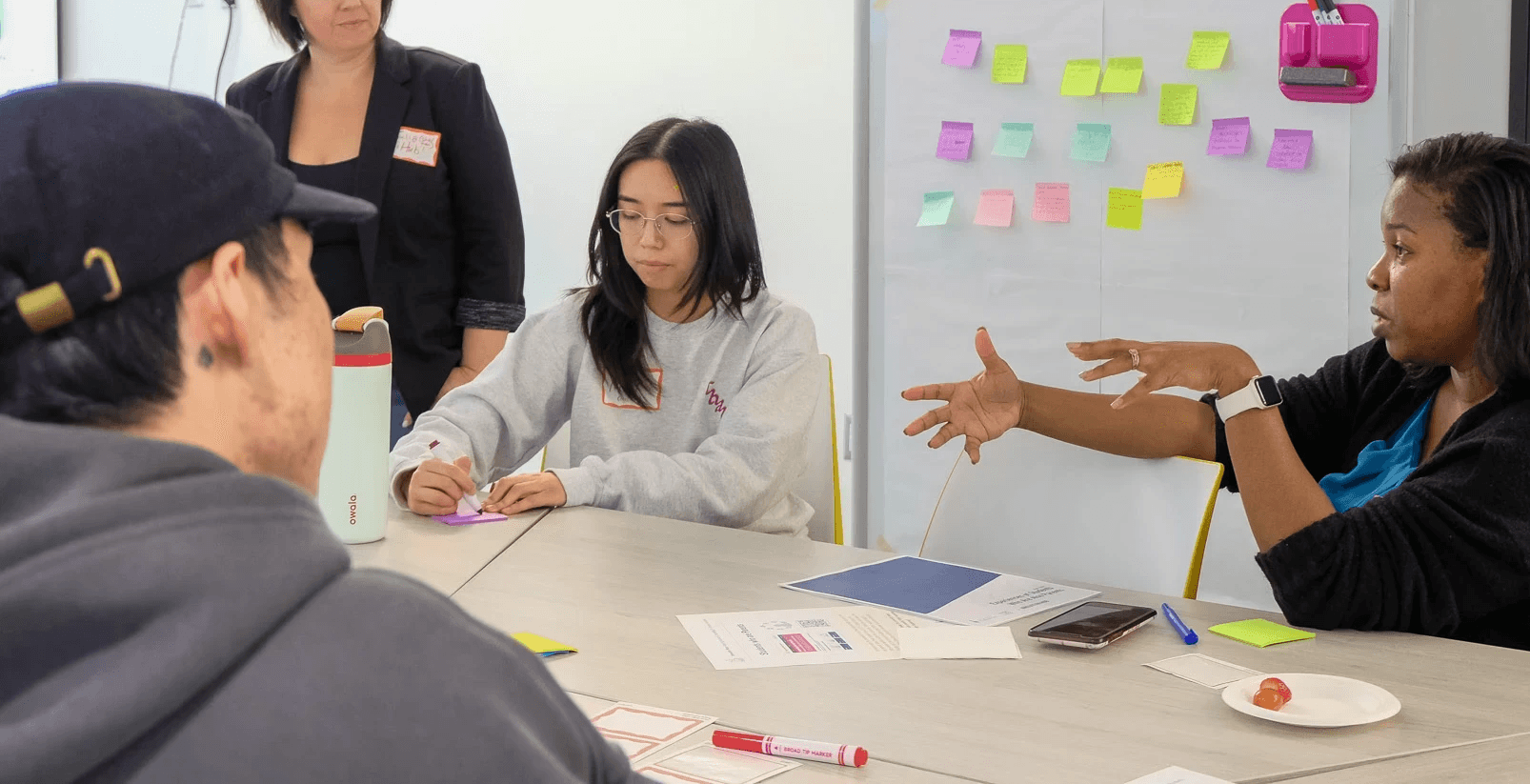
I guided the synthesis of qualitative data across stakeholder groups, using Miro and whiteboarding activities to identify recurring themes and translating those findings into 3 personas that represented distinct student needs and experiences. I also coordinated 5 co-creation sessions to design with students. We used their feedback to challenge, refine, and validate the insights. Finally, I directed the consolidation of these findings into design principles and recommendations, which we presented to our partner and supporting staff as a framework for guiding future student support.
OUTCOME
From Data to Insight to Delivery
Final insights were delivered and presented to the Office of Vice Provost, Students and other support staff to deepen their understanding of the student leader experience and inform the design of future student leader support.
Bringing it all together, we delivered a final solution that includes…
A detailed report with insights supported by data examples
Data-driven personas alongside current and future state scenarios
A set of actionable design guidelines and recommendations
Impact on Student Leader Experiences
Our design research surfaced real student needs and shifted stakeholder perspectives, helping them see new opportunities for action. The work was shared campus-wide and made publicly available to broader university members to shed light on the experiences of this group of students.
Overall, our work has contributed to…
Building greater awareness of student leader and staff perspectives to support more collaborative partnerships
Expanding thinking beyond resource considerations to include broader human needs at the heart of this complex problem
Demonstrating how design research can uncover underlying needs that should be addressed in order to build more constructive collaboration across the institution